Freelance invoicing in the UK comes down to two things: putting the right details on the invoice, and making it clear when and how you want to be paid. A sole trader invoice does not need your UTR, a special layout or anything from HMRC. It does need the details below.
What a UK sole trader invoice should include
According to GOV.UK, a UK sole trader invoice should include:
- your name, and your business name if you use one, plus your contact details. If you trade under a business name, also give an address where legal documents can be delivered to you.
- the customer’s name and address
- a unique invoice number
- the invoice date and the date of the work
- what you did or supplied, the amount for each item, and the total owed
- your payment terms and bank details
- VAT details, only if you’re VAT-registered: your VAT number, the rate and the VAT amount for each line
You don’t need to put your UTR on an invoice. CIS subcontractors give their UTR to contractors separately so they can be verified.
How to get paid sooner
Nobody can promise you a number of days, but these habits make late payment less likely.
- Send the invoice the day you finish. Every day you wait to send it pushes back the day you are paid. Sending from your phone when the job is done takes a couple of minutes.
- Put a due date on it. You can set your own payment terms, including payment upfront or discounts for early payment. If you do not agree a date, the customer has 30 days from getting your invoice or the work (GOV.UK).
- Make paying easy. Show your bank details and ask the customer to use the invoice number as the payment reference, so you can match the payment to the job.
- Follow up on the due date. If it has not arrived, send a short, polite message the next day and keep a note of when you sent it.
- Know your rights on late payment. If another business pays you late, you can charge statutory interest of 8% above the Bank of England base rate, plus fixed compensation of £40, £70 or £100, depending on the size of the debt. You cannot claim statutory interest if your contract sets a different rate. Send a new invoice for the interest and compensation (GOV.UK).
Keep invoices with the rest of your records
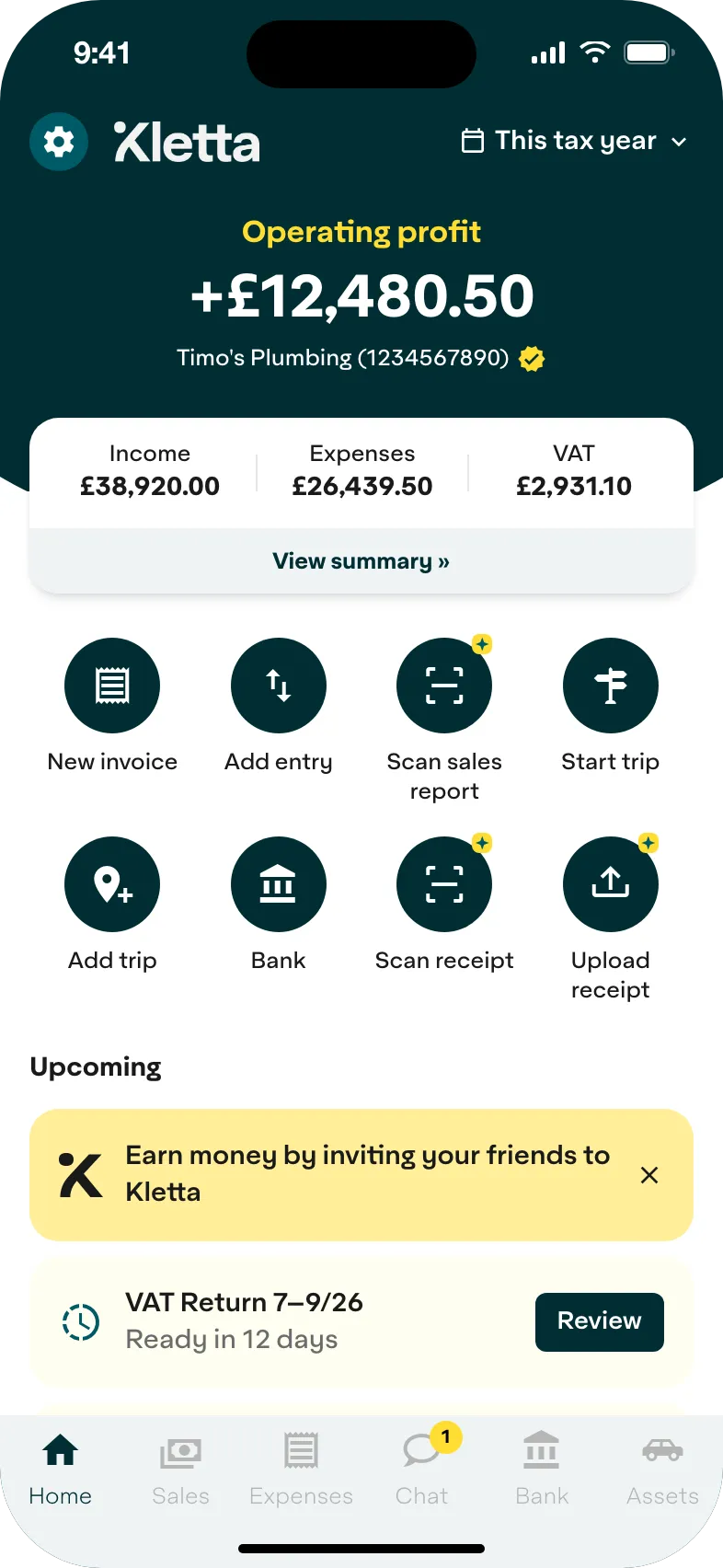
Whatever you use to send invoices, the income has to end up in your records. With Kletta you send the invoice from your phone and it is already in your books, next to your receipts and allowable expenses. You do not copy it across.
Freelance invoicing: common questions
Do freelancers need to comply with Making Tax Digital (MTD)?
Only if your gross income from self-employment and property is above the thresholds: over £50,000 from April 2026, over £30,000 from April 2027 and over £20,000 from April 2028. For 2026/27, HMRC looks at your 2024/25 tax return. If it applies to you, you keep digital records and send quarterly updates and your tax return from software that works with Making Tax Digital. If it doesn’t, you still send a Self Assessment tax return by 31 January.
Is my UTR required on an invoice?
No. Leave it off. Share it with HMRC and, if you work under the Construction Industry Scheme, with your contractor.
Can I charge interest on a late invoice?
If the customer is a business, yes. See the late payment steps above for the rate and the fixed amounts. You can also choose not to charge it.
Do I need accounting knowledge to invoice as a freelancer?
No. An invoice is a bill with the right details on it. Keep a copy of every invoice and a record of when it was paid, and your bookkeeping will match.
Kletta is HMRC-recognised Making Tax Digital software for sole traders. Keeping your books and building your tax return is free. You pay only when you’re ready to send to HMRC (see pricing). Not in Making Tax Digital yet? Get Kletta Duo free until your first Making Tax Digital deadline.