The deadline for your 2025/26 Self Assessment tax return is 31 January 2027 if you file online. It’s also the day to pay the tax you owe for 2025/26, and, if they apply to you, your first payment on account for 2026/27. Below are all the dates for this tax year, what happens if you’re late and what to do if you can’t pay.
In short
- Online tax return: 31 January 2027. Paper return: 31 October 2026, which has passed, so file online.
- Pay your tax by 31 January 2027. That’s a Sunday, so a bank transfer that isn’t a Faster Payment needs to reach HMRC by Friday 29 January.
- A late return costs £100 straight away, even if you owe no tax, and more the later it gets.
- Late payment adds interest from 1 February 2027 and penalties after 30 days.
- If you can’t pay in full, you may be able to set up a payment plan with HMRC.
Self Assessment deadlines for the 2025/26 tax year
The 2025/26 tax year ran from 6 April 2025 to 5 April 2026. These are its deadlines (GOV.UK):
| Date | What’s due |
|---|---|
| 6 April 2026 | Earliest day to send your 2025/26 return |
| 5 October 2026 | Register for Self Assessment, if you haven’t sent a tax return before |
| 31 October 2026 | Paper tax return, by 11:59pm |
| 30 December 2026 | Online return, if you want tax under £3,000 collected through your PAYE tax code |
| 31 January 2027 | Online tax return, by 11:59pm. Pay the tax you owe for 2025/26 and your first payment on account for 2026/27 |
| 31 July 2027 | Second payment on account for 2026/27 |
| 31 January 2028 | Last day to correct your 2025/26 return |
Collecting tax through your tax code only works if you already pay tax through PAYE, for example from a job or pension, and you owe less than £3,000 (GOV.UK).
Payments on account are advance payments towards next year’s bill, including Class 4 National Insurance. Each one is half of last year’s bill. They apply if your last bill was £1,000 or more, unless more than 80% of your tax was already taken at source, for example through a job (GOV.UK).
Registered after 5 October?
If you told HMRC after 5 October 2026 that you need to file, HMRC gives you a separate filing deadline: three months from the date on its letter or email. The tax still has to be paid by 31 January 2027 (GOV.UK).
31 January 2027 is a Sunday
The filing deadline doesn’t move: HMRC’s online service works at weekends, so you can still send your return on Sunday 31 January.
Paying is different. If the deadline falls on a weekend, your payment must reach HMRC on the last working day before, Friday 29 January 2027, unless you pay by Faster Payments or by debit or corporate credit card (GOV.UK). A Bacs transfer can take three working days, so allow for that.
Missed the paper deadline?
If you didn’t send a paper return by 31 October 2026, you don’t get a penalty as long as you file online by 31 January 2027. Our step-by-step guide shows how to file your Self Assessment tax return.
What happens if you file late?
The penalty for a late return depends on how late it is (GOV.UK):
| How late | Penalty |
|---|---|
| 1 day to 3 months | £100 |
| After 3 months | £10 a day, for up to 90 days (up to £900) |
| After 6 months | 5% of the tax due or £300, whichever is higher |
| After 12 months | Another 5% of the tax due or £300, whichever is higher |
The £100 applies even if you owe no tax, or have already paid it (GOV.UK). The penalties add up: a return that’s 12 months late can cost £1,600 or more before interest. HMRC has a penalty estimator if you want to check your own figure.
These penalties apply to 2025/26 returns, even if you started Making Tax Digital in April 2026 (GOV.UK). The exception is people who volunteered for Making Tax Digital during 2025/26: they agreed to the new penalty points system instead. Our guide to MTD penalties explains how points work.
What happens if you pay late?
Late payment has its own charges, on top of any penalty for filing late:
- Interest runs on unpaid tax from the day after the deadline and is worked out daily. The rate is the Bank of England base rate plus 4%, which makes it 8% from 24 November 2026 (GOV.UK).
- Late payment penalties of 5% of the tax still unpaid are added at 30 days, 6 months and 12 months after the deadline (GOV.UK).
Filing on time still matters if you can’t pay: it avoids the filing penalties and gives you an exact figure to plan around.
What if you have a reasonable excuse?
If something stopped you filing or paying on time for a valid reason, such as a serious illness, the death of a close relative shortly before the deadline, a computer failure or problems with HMRC’s online services, you can appeal a penalty. Send your return or payment as soon as you’re able to (GOV.UK).
You usually have 30 days from the date of the penalty to appeal. You can appeal online or by post (GOV.UK).
These don’t count as a reasonable excuse: not having enough money, finding HMRC’s online system too difficult, not getting a reminder from HMRC, or a mistake on your return.
What if you can’t pay your tax bill?
File your return anyway, then look at a payment plan. HMRC can let you spread the bill over monthly payments, and you can set one up online if you (GOV.UK):
- are up to date with your tax returns
- owe £30,000 or less
- have no other tax debts and no other HMRC payment plans.
You can’t set up a plan until you’ve filed your return. Payments are taken by Direct Debit, and interest at base rate plus 4% is added, but a plan helps you avoid late payment penalties. If you owe more, or don’t meet the conditions, call HMRC instead.
If your income has fallen, your payments on account may also be too high. You can reduce your payments on account when you file.
How does Making Tax Digital change the dates?
Not for this return. Your 2025/26 return is due on 31 January 2027 as usual, even if you joined Making Tax Digital in April 2026.
From the 2026/27 tax year, sole traders with income from self-employment and property over £50,000 send quarterly updates as well as their tax return. The return for 2026/27 is still due on 31 January 2028. Our MTD deadlines for 2026/27 has every date.
Two more changes are coming. From April 2027, a penalty points system replaces the late filing penalties above for everyone who sends a Self Assessment return. And the return you’re sending now decides who joins Making Tax Digital next: if your self-employment and property turnover on your 2025/26 return is over £30,000, you start on 6 April 2027 (GOV.UK).
How to avoid the January rush
You can file your return as soon as the tax year ends on 5 April. Filing early doesn’t mean paying early: the bill is still due on 31 January. But you know the figure months in advance, you can set money aside for it, and you don’t find a mistake on the last weekend of January.
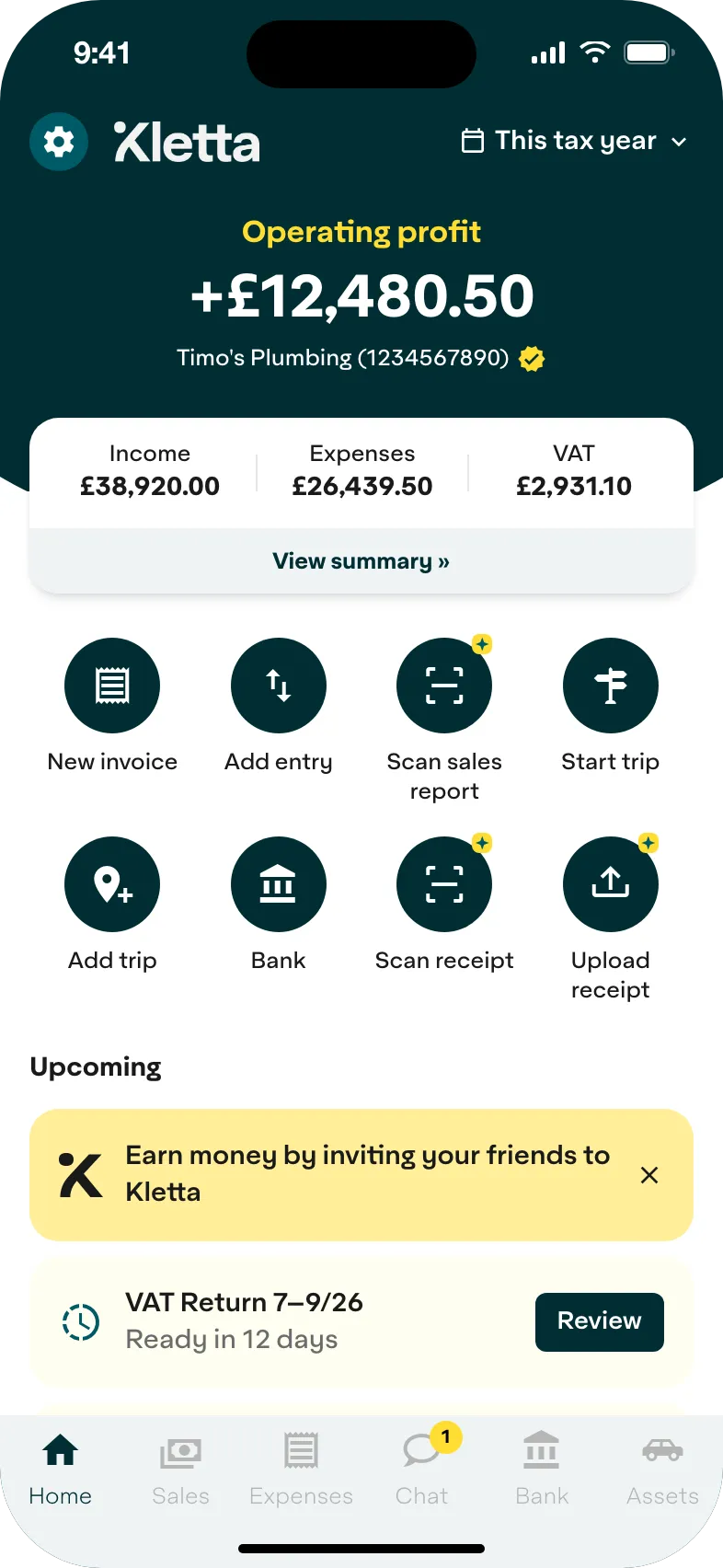
Keeping your income and receipts up to date during the year makes that easy. Kletta builds your tax return as you go. You check it and send it to HMRC from the app, and with Solo you pay a £29 filing pass only when you send.
Frequently asked questions
What time is the Self Assessment deadline?
Your online return must be sent by 11:59pm on 31 January 2027. The payment deadline is the same day, but because it’s a Sunday, your payment must reach HMRC by Friday 29 January, unless you pay by Faster Payments or by debit or corporate credit card.
Is the deadline moved because 31 January 2027 is a Sunday?
No. You can still file online on Sunday 31 January. For paying, see the Sunday section above: most bank transfers need to arrive by Friday 29 January.
Do I need to pay when I file?
No. You can file any time before the deadline and pay by 31 January 2027.
When is the deadline for my 2026/27 tax return?
31 January 2028 for an online return, and 31 October 2027 for paper.
I don’t think I need to file this year. What should I do?
If HMRC has asked you to send a return and you don’t think you need to, tell HMRC by 31 January 2027. Otherwise you can get a late filing penalty, even if you owe nothing. You can check if you need to send a tax return on GOV.UK.
Kletta is HMRC-recognised Making Tax Digital software for sole traders. Keeping your books and building your tax return is free, and you pay only when you send it to HMRC (see pricing).