Deliveroo riders are self-employed. Deliveroo pays you your fees and tips in full, with no Income Tax or National Insurance taken off, so it’s your job to register with HMRC, keep records and pay your tax through a Self Assessment tax return.
That sounds like a lot. In practice it comes down to five things: register, keep your statements, track your miles, claim your costs and put money aside.
1. Register for Self Assessment
If you earn more than £1,000 a year from delivering (before costs), you need to register for Self Assessment as a sole trader. The deadline is 5 October after the end of the tax year you started in.
So if you did your first Deliveroo shift between 6 April 2026 and 5 April 2027, register by 5 October 2027. Your first tax return and payment are then due by 31 January 2028.
You don’t need to set up a company or open a business bank account to start, but a separate account makes your records much easier to check.
2. Everything you earn counts
Your income is everything the apps pay you: delivery fees, boosts, bonuses and tips. Tips are taxable, even though Deliveroo passes them on in full.
If you ride for more than one app, such as Uber Eats or Just Eat as well, it’s all one business. Add the income together on one tax return.
Delivery apps now send HMRC details of what they pay the people who work through them, under the reporting rules for digital platforms. HMRC can compare those figures with your return, so keep the statements Deliveroo gives you and make sure your totals match.
3. Track your miles (if you ride a scooter, motorbike or drive)
Most riders cut their tax bill the most by claiming their travel. If you use a car or motorbike, the simplest way is HMRC’s flat mileage rate for the 2026/27 tax year:
| Vehicle | Rate |
|---|---|
| Motorbike or moped | 24p a mile |
| Car or van, first 10,000 business miles | 55p a mile |
| Car or van, after 10,000 miles | 25p a mile |
The rate covers fuel, insurance, servicing, repairs and wear, so you can’t claim those as well. Parking and congestion charges on a delivery can be claimed on top. Fines can’t.
Business miles are the miles you ride while logged in and working: to the restaurant, to the customer and between orders. The trip from home to your first pickup and back at the end can be less clear-cut, so read our mileage allowance guide before you count them.
You can claim actual vehicle costs instead of the flat rate. Whichever you pick, you normally have to stick with it for that vehicle.
On a bicycle or e-bike?
There’s no flat mileage rate for bicycles if you’re self-employed. Instead, claim what you actually spend: the bike itself, repairs, tyres, lights, a lock and charging costs for an e-bike. Under the cash basis most riders use, buying the bike can usually be claimed as an expense in the year you pay for it. Keep the receipts.
4. Claim your other costs
Common costs you can claim as a rider include:
- your phone and data, for the share you use for work (for example 50% if half your use is deliveries)
- your delivery bag, phone mount, power bank and waterproofs bought for riding
- food delivery insurance (hire and reward cover) on a bike, or on a car or motorbike if you claim actual costs rather than mileage
- accounting software, and bank or card fees on your business account
You can’t claim everyday clothes, your meals on shift or anything you’d buy anyway. See our full list of allowable expenses for sole traders, or HMRC’s expenses guidance.
If your costs are very low, the £1,000 trading allowance may give a better result than claiming them. You can use one or the other, not both.
5. Put money aside for tax: a worked example
Here’s an illustrative year for a full-time scooter rider in 2026/27, with no other job or income:
| Item | Amount |
|---|---|
| Deliveroo fees and boosts | £18,000 |
| Tips | £1,200 |
| Total income | £19,200 |
| 9,000 business miles × 24p | £2,160 |
| Phone (50% of £360) | £180 |
| Delivery bag and kit | £60 |
| Total expenses | £2,400 |
| Taxable profit | £16,800 |
The first £12,570 of profit is covered by the Personal Allowance. On the remaining £4,230:
- Income Tax at 20% = £846.00
- Class 4 National Insurance at 6% = £253.80
- Total tax bill: £1,099.80
That’s about 6% of everything that came in. If you also have a job, more of your Deliveroo profit is taxed, because your wages normally use up your Personal Allowance. A rough rule is to move 20% of each week’s earnings into a separate savings pot, and you’ll rarely be caught short.
Because this bill is over £1,000, HMRC will normally also ask for payments on account: advance payments towards next year’s bill, due on 31 January and 31 July. Your first January bill can be a lot bigger than you expect, so plan for it.
Class 2 National Insurance is no longer charged. If your profit is under £7,105, you can choose to pay voluntary Class 2 at £3.65 a week to protect your State Pension. See HMRC’s National Insurance rates.
Keep your records for five years
Keep your Deliveroo statements, receipts and mileage log for at least five years after the 31 January deadline for that tax year. A screenshot of the app’s map isn’t a mileage log: note the date, the miles and that it was a delivery shift.
Making Tax Digital is coming for busy riders
From April 2027, sole traders with qualifying income over £30,000 (from 2025/26) must use Making Tax Digital software and send HMRC quarterly updates. From April 2028, the threshold drops to £20,000. That’s your income before expenses, so a full-time rider can be over it quickly. Check HMRC’s eligibility guidance.
Frequently asked questions
Does Deliveroo pay my tax for me?
No. Deliveroo riders are self-employed, so Deliveroo pays you gross. You work out and pay your own tax through Self Assessment.
Do I need to register if I only ride part time?
If your total delivery income, from every app, is more than £1,000 in a tax year, yes. Under £1,000, the trading allowance means you usually don’t need to.
Do I need to register for VAT?
Only if your taxable turnover goes over £90,000 in a 12-month period, which very few riders reach.
What if I’ve missed the registration deadline?
Register as soon as you can. Any penalty is based on the tax left unpaid, and it’s usually lower if you tell HMRC before they contact you.
Keep it on your phone, between orders
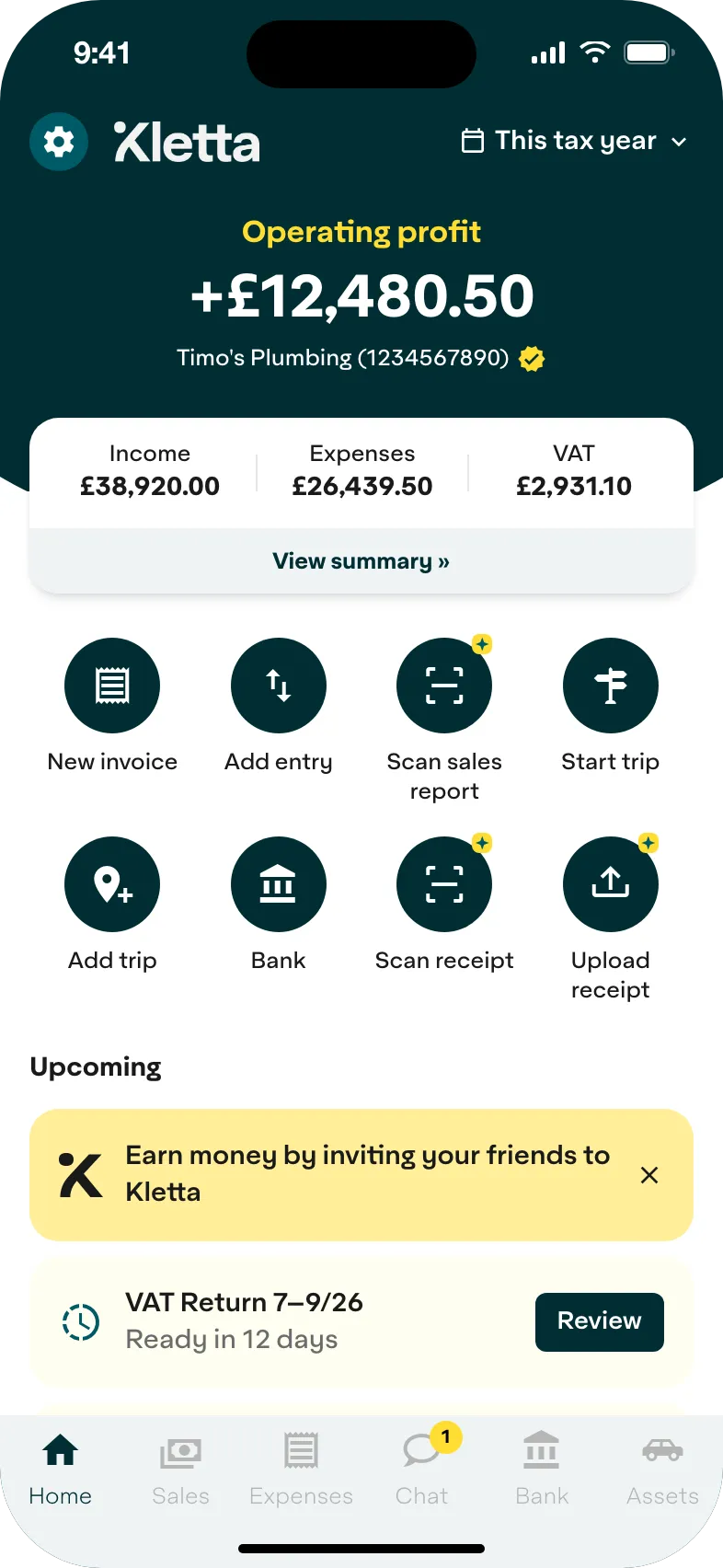
Kletta lets you photograph receipts, log your mileage and see your tax bill build up as you go, all from your phone. When it’s time to file, your tax return is already done. See how Kletta works for sole traders.
Kletta is HMRC-recognised Making Tax Digital software for sole traders. Riding for Deliveroo? See Kletta for Deliveroo riders and what it costs riders. For other sole traders, keeping your books and building your tax return is free, and you pay only when you’re ready to send to HMRC (see pricing). Not in Making Tax Digital yet? Get Kletta Duo free until your first Making Tax Digital deadline.