If you deliver for Deliveroo, Uber Eats or Just Eat on a moped or motorbike, you can claim 24p for every business mile in 2026/27. In a car or van it’s 55p a mile for the first 10,000 business miles, then 25p. On a bicycle or e-bike there’s no mileage rate, so you claim what you actually spend.
For most couriers, mileage is the biggest expense on the tax return. Here’s how to get it right.
Mileage rates for couriers in 2026/27
These are HMRC’s flat rates for vehicles for the tax year 6 April 2026 to 5 April 2027:
| Vehicle | Rate |
|---|---|
| Motorbike, moped or scooter | 24p a mile |
| Car or van, first 10,000 business miles | 55p a mile |
| Car or van, after 10,000 miles | 25p a mile |
| Bicycle or e-bike | No flat rate: claim actual costs |
The car and van rate went up from 45p on 6 April 2026. If you’re filling in your 2025/26 tax return, due by 31 January 2027, use 45p for that year.
The flat rate covers fuel, insurance, servicing, repairs and wear on the vehicle, so you can’t claim those separately as well. You can claim parking on top. Fines and penalty charges can’t be claimed.
Which miles count?
Business miles are the miles you travel for your delivery work. For a courier, that clearly includes:
- riding to the restaurant or shop to collect an order
- riding from there to the customer
- riding from one drop-off to the next pickup
Miles ridden between orders while you’re logged in and available, such as heading back towards a busy area, are part of doing the job too. Keep a note that you were on shift.
Personal trips don’t count, even in the middle of a shift. If you log off to go to the shops or see a friend, those miles are private.
What about getting from home to your first order?
This is the part to be careful with. HMRC’s general rule is that travel between home and work can’t be claimed.
There is an exception for people with no fixed place of work who run their business from home and travel to a different place for each job. HMRC’s own manual (BIM37620) says each case depends on its facts.
A practical approach: if you log in at home and accept orders from your door, you have a better argument that the shift starts there. If you always ride to the same zone before you log in, treat that trip like a commute and leave it out. If these miles add up to a lot of money for you, ask an accountant.
Flat rate or actual costs?
You have two ways to claim for a motorbike, car or van:
- The flat rate: business miles × the rate above.
- Actual costs: the business share of what you really spent on fuel, insurance, servicing, repairs, vehicle tax and breakdown cover.
Here’s an illustrative comparison for a courier who rides a scooter 9,000 business miles in 2026/27, with 90% of the scooter’s use being deliveries:
| Flat rate | Actual costs | |
|---|---|---|
| 9,000 miles × 24p | £2,160 | |
| Fuel | £700 | |
| Food delivery insurance | £900 | |
| Servicing and tyres | £350 | |
| Vehicle tax and MOT | £60 | |
| Total running costs | £2,010 | |
| Business share (90%) | £1,809 | |
| Claim | £2,160 | £1,809 |
Here the flat rate gives £351 more, with far less paperwork. This comparison leaves out the cost of the scooter itself. Under actual costs you can usually claim the business share of that too, which can change the answer in the year you buy it.
In a car, the same 9,000 miles at 55p gives a £4,950 claim, which is hard to beat with actual costs unless your car is expensive to run.
Two rules to know before you choose:
- Once you use the flat rate for a vehicle, you must keep using it for as long as you use that vehicle in your business.
- You can’t use the flat rate for a vehicle if you’ve already claimed its purchase price as an expense or through capital allowances.
You choose per vehicle. If you swap your scooter for a car mid-year, each one gets its own method and its own rate.
Bicycles and e-bikes
HMRC’s flat rates only cover cars, vans and motorcycles. The 20p a mile you may have seen for bicycles is for employees, not for the self-employed.
Instead, claim the business share of what you actually spend:
- the bike or e-bike itself
- repairs, tyres, chains and brake pads
- lights, a lock and a helmet bought for work
- charging an e-bike battery
- food delivery insurance
For example, if you buy a £1,400 e-bike and spend £200 on repairs in the year, and 90% of your riding is deliveries, you can claim £1,440 (90% of £1,600). Under the cash basis, which most sole traders use, the bike is usually claimed in the year you pay for it. Keep the receipts.
You don’t need a mileage log for a bicycle, but you do need a fair way to show how much of its use is work.
What mileage records to keep
To use the flat rate you need a record of your business miles. For each shift, note:
- the date
- the business miles you covered
- that it was delivery work, and for which app
The simplest way is to note your mileage reading when you log in and again when you log off, then take off any private miles in between.
Don’t rely on the delivery app alone. The trip distances apps show may not include your miles to the restaurant or between orders, and the estimate can be shorter than the route you actually rode. Use the app’s order history as back-up that you were working on that day.
Keep your records for at least five years after the 31 January deadline for that tax year.
Frequently asked questions
Can I claim mileage and fuel?
No. The flat rate already includes fuel. Claim one or the other.
Can I claim mileage on a bicycle?
Not at a flat rate. Claim your actual costs, such as the bike, repairs and parts.
Do I need receipts for fuel if I use the flat rate?
No. You need your mileage log. Keep receipts for anything you claim on top, such as parking.
I ride for two apps. Do I get two 10,000-mile limits?
No. The 10,000-mile limit for cars and vans applies to all your business miles in the tax year added together.
Does mileage reduce my tax bill pound for pound?
No. It reduces your taxable profit. A £2,160 mileage claim saves a basic rate taxpayer about £562 in Income Tax and National Insurance (26% of £2,160).
Log the miles when you finish your shift
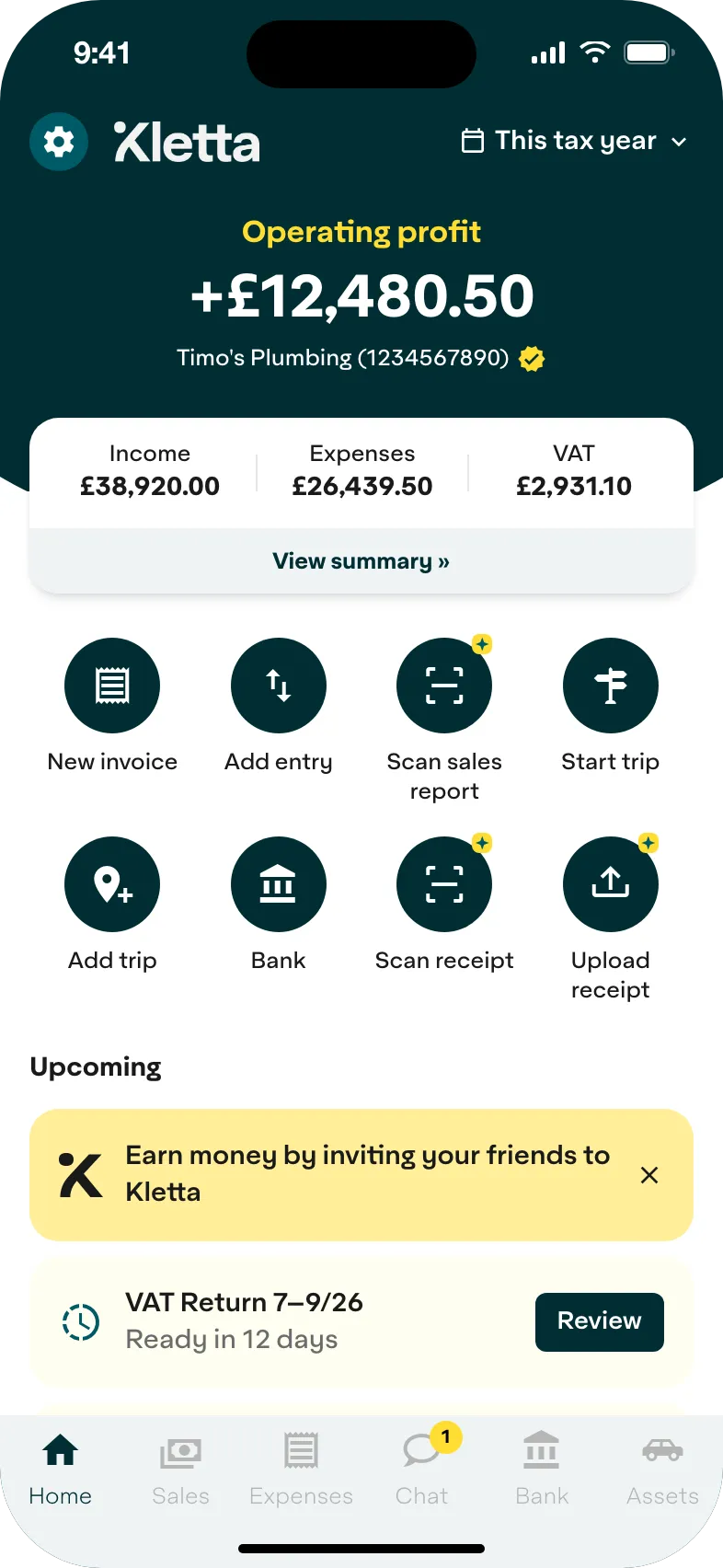
Mileage is easy to lose because no receipt turns up. Kletta lets you log each shift’s miles on your phone, next to your receipts and income, and works out the claim for you. See how Kletta works for sole traders.
For the rest of your tax as a courier, read our Deliveroo rider tax guide. For the wider rules, see our sole trader mileage allowance guide.
Kletta is HMRC-recognised Making Tax Digital software for sole traders. Keeping your books and building your tax return is free. You pay only when you’re ready to send to HMRC (see pricing). Not in Making Tax Digital yet? Get Kletta Duo free until your first Making Tax Digital deadline.