


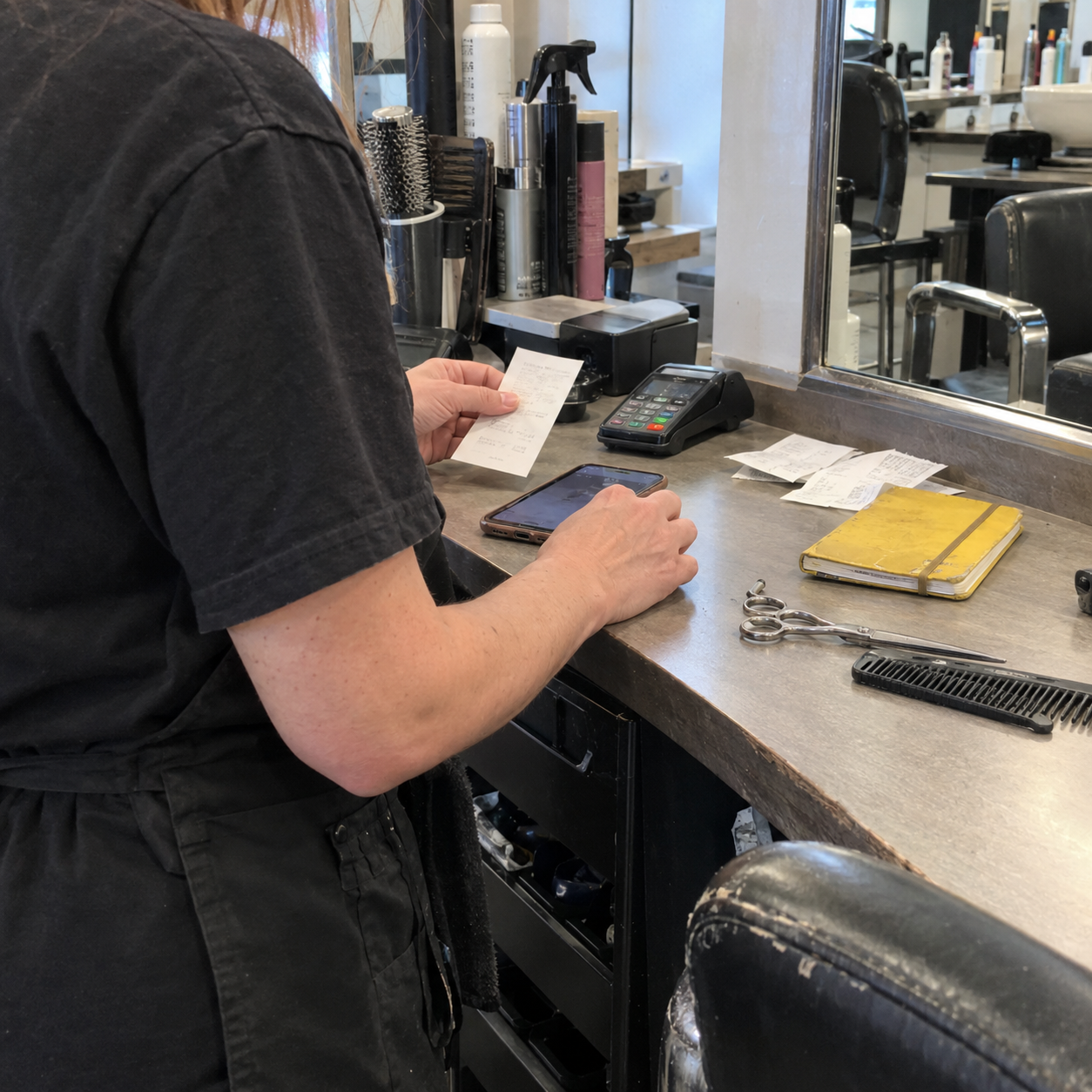
Your last client has left. There is colour on your sleeve, a supplier receipt in your bag and a card payment that has not reached your bank yet.
You know you have been busy. Working out what you actually earned takes a little more thought.
Self-employed hairdresser bookkeeping becomes much easier when you separate three things: what customers paid, what running your business cost and what moved through your bank account. They will not always be the same number.
Here is how to keep the picture clear, whether you rent a chair, work from a studio or visit clients at home.
Start with who the customer is paying
Before choosing categories or downloading statements, make sure you understand your working arrangement.
Renting a chair does not, by itself, prove that you are self-employed. HMRC considers your contract and how you actually work. Its employment status guidance for hair and beauty is a useful starting point if you are unsure.
If you run your own sole trader business, your records need to show its income and expenses. A booking diary tells you who sat in the chair. Your bookkeeping needs to tell you what happened to the money.
Record the sale before the card fee disappears
Imagine a client pays £80 by card. Your payment provider deducts £1.60 and transfers £78.40 to you.
For a straightforward, non-VAT-registered example, record the £80 sale and the £1.60 processing fee separately. The £78.40 is the amount settling into your bank.
Recording only the payout hides part of the sale. Recording the £80 sale and then treating the £78.40 bank deposit as another sale counts the same income twice.
The same principle applies when several appointments arrive as one payout: keep the provider’s statement, match the deposit to it and check what has already been recorded.
For each day, keep track of cash takings, card sales, bank transfers and tips. Customer tips should not disappear from your records just because they arrived in cash; HMRC explains the tax treatment in its guidance on tips and tax.
Paying cash takings into your bank later is a transfer of money you already recorded. It is not another haircut.
What if the salon collects the money?
This is where chair renters can lose the thread.
If the salon collects your customers’ payments on your behalf and deducts your chair rent before paying you, the bank deposit alone will not explain your sales and costs. Keep the salon statement showing the takings, deductions and amount paid to you.
However, do not assume every percentage split works this way. If your agreement is that the salon sells the service and pays you for your work, the recording can differ. Check who supplies the service to the customer and what your agreement says.
The useful question is: what does this payment represent? Ask the salon or your bookkeeper before building a routine around the wrong answer.
What one working week might look like
Here is an illustrative week for a self-employed stylist who takes customer payments directly, uses cash basis accounting and is not VAT registered. All the listed sales, fees and costs are received or paid during the week, with no other transactions.
| Item | Amount |
|---|---|
| Card payments for appointments | £900 |
| Cash payments for appointments | £300 |
| Cash tips | £35 |
| Total business income | £1,235 |
| Chair rent paid | £180 |
| Colour and consumables bought for work | £95 |
| Card processing fees | £18 |
| Total business expenses | £293 |
| Income less the listed expenses | £942 |
The card provider pays £882 into the bank: £900 less £18 in fees. Cash received totals £335, including tips. Deduct the £275 spent on chair rent and supplies and the same £942 remains.
That is a useful check. It is not a tax calculation or a promise that £942 is available to spend personally. Other business costs and tax still need to be considered.
Keep the receipts for the costs behind the appointments
Chair rent, colour, gloves and foils are easy to remember. The smaller costs often get missed because they arrive between everything else.
Keep evidence of business purchases such as booking software, card processing fees, business insurance and marketing. For mixed costs, such as a phone used for both work and personal calls, claim only the business proportion. Equipment can need different treatment depending on your accounting method.
HMRC’s allowable expenses guidance sets out the rules. Our guide to allowable expenses for sole traders gives you a broader checklist without turning this weekly routine into a tax textbook.
Taking money out to pay yourself is different from paying a business expense. Keep those withdrawals identifiable too.
A weekly routine you can actually keep
Choose a point in the week when the appointment book is closed and the payment statements are available. Then:
- Check that the week’s customer payments and tips are recorded.
- Match card or salon payouts to the statements, including deductions.
- Add receipts for supplies, chair rent and other business costs.
- Investigate anything missing, duplicated or unfamiliar.
- Look at income after expenses before deciding what to transfer to yourself.
Save receipts when you get them. Trying to remember a £23.80 purchase three months later is a much harder job than photographing it at the counter.
HMRC lists the business records you need to keep, including sales, expenses and supporting evidence. Records must normally be kept for at least five years after the relevant 31 January filing deadline.
Keep MTD in the background while you build the habit
Making Tax Digital for Income Tax adds digital records and quarterly updates for affected sole traders. Whether it applies to you depends on your qualifying income and circumstances.
For April 2027 entry, the relevant threshold is more than £30,000 of qualifying self-employment and property income in 2025/26, subject to exemptions. That is income before expenses, rather than profit.
Check HMRC’s eligibility guidance, or read our explanation of Making Tax Digital for sole traders.
Frequently asked questions
Can I claim chair rent as a business expense?
Chair rent paid for your self-employed business will generally be a business cost. Keep the agreement and invoices or statements, and check that deductions taken by the salon have not already been recorded elsewhere.
Do I need a separate business bank account?
A sole trader may be able to use a personal or business account, but the bank’s terms must allow business use. A separate account can make matching salon payouts, purchases and personal withdrawals much simpler.
How long should I keep hairdressing receipts?
Normally, at least five years after the 31 January submission deadline for the relevant tax year. HMRC explains the timing in its record retention guidance.
Give yourself a clearer view of the week
Kletta helps hair and beauty sole traders upload salon statements, scan receipts and record income and expenses from their phone. You can check what has been recorded while the week’s appointments are still fresh in your mind.
See how Kletta works for hair and beauty professionals, or compare the sole trader plans.